Category: Uncategorized
Millennium Science – 10x Genomics Grant Value Multiplier Program



Make your research funding go further
Planning an upcoming grant application?
The Millennium Science – 10x Genomics Grant Value Multiplier Program is designed to help Australian and and New Zealand Early and Mid Career Researchers (EMCRs) incorporate single cell and spatial biology into upcoming grant applications and get more value from their research funding.
Register your eligible grant project before submission and include 10x Genomics consumables in your proposed grant budget. If your grant is successfully awarded, you could receive an additional 50% in eligible 10x Genomics consumable value, helping you expand the scope and impact of your research.
Register your grant project using the form below:
Turn your grant funding into more research
Turn your grant funding into more research
Receive an additional 50% in eligible 10x Genomics consumable value, with no maximum cap.
The Grant Value Multiplier scales with your qualifying 10x Genomics purchase. The more eligible 10x Genomics consumables included in your successful grant, the greater the additional value you can unlock.
For example only:
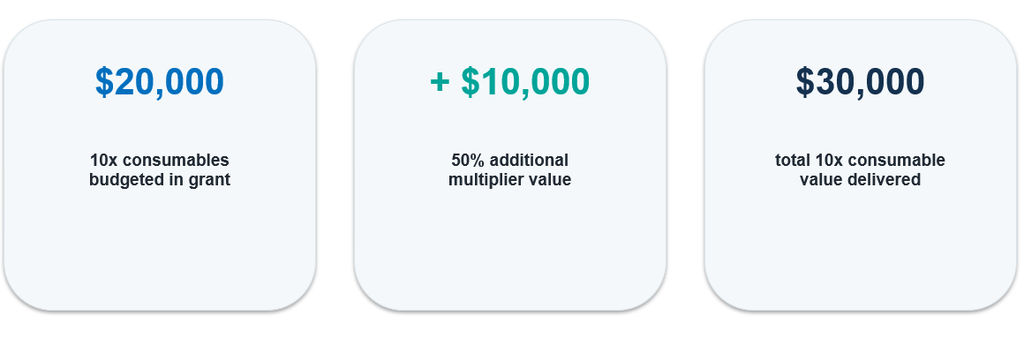
Planning $20,000 of eligible 10x Genomics consumables in your grant?
$20,000 grant budget + $10,000 Grant Value Multiplier = $30,000 total potential 10x Genomics consumable value
That additional value could help you analyse more samples, explore more biology or extend the scope of your study, without increasing the 10x Genomics budget requested in your grant.
Who is eligible?
The program is open to Australian and New Zealand researchers and research teams preparing eligible competitive research grant applications.
Early and Mid Career Researchers (EMCRs), as defined by the relevant funding scheme or institution, are particularly encouraged to apply.
You may be eligible if you:
• Are an Australian and New Zealand based researcher or research team
• Are preparing an eligible competitive research grant application
• Plan to include eligible 10x Genomics consumables in your proposed project budget
• Register your project with Millennium Science before submitting your grant application
• Proceed with the eligible 10x Genomics purchase if your grant is successfully awarded
Relevant funding opportunities may include ARC, NHMRC and MRFF schemes, as well as eligible university seed and pilot grants, philanthropic grants and disease specific research funding.
Not sure whether your grant is eligible? Register your interest and our team can help.
How it works
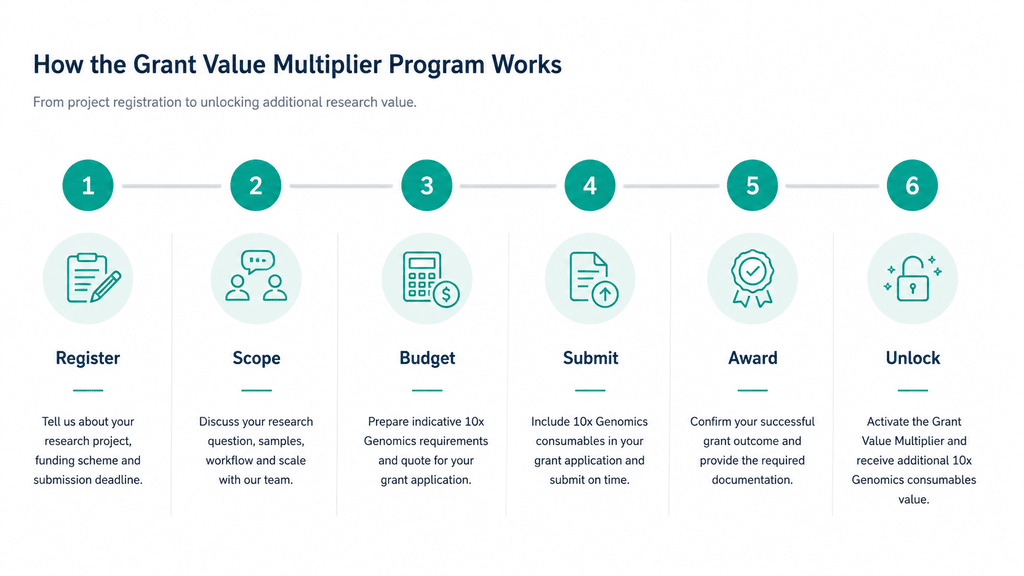
1. Register your grant project
Tell us about your research, funding scheme and submission deadline.
2. Plan your 10x Genomics component
Our team can help you scope the technology, experimental requirements and indicative budget.
3. Prepare your grant budget
Work with our team to determine indicative 10x Genomics requirements and obtain a quote for your grant application.
4. Include 10x Genomics in your grant application
Submit your application with eligible 10x Genomics consumables included in your proposed project budget.
5. Let us know when your grant is awarded
Once your successful grant and eligible purchase are confirmed, your project can proceed through the Grant Value Multiplier process.
6. Unlock additional research value
Receive additional eligible 10x Genomics consumables equivalent to 50% of the qualifying purchase value, subject to program terms and conditions.
More than a funding multiplier
You don’t need to have every detail of your experiment worked out before you register.
Before submission, Millennium Science and 10x Genomics can connect you with support to help plan the 10x Genomics component of your grant, including:
• Experimental scoping based on your research question
• Single cell and spatial technology selection
• Study design and sample planning
• Indicative consumable requirements and quotation support
• Technical resources and relevant publications
• Access to local service providers and core facilities where required
• 1:1 Grant Planning Sessions with our sales and technical teams
Our goal is to help you build a scientifically appropriate and realistically budgeted 10x Genomics component into your proposal.
Planning an upcoming grant?
Whether you’re planning your first single cell experiment, adding spatial biology to an established research program, or looking to increase the scale of your next study, start the conversation before you submit your application.
Register your grant project using the form below:
Have a project in mind but aren’t sure what to include in your grant? Request a 1:1 Grant Planning Session to discuss your project with the Millennium Science and 10x Genomics team.
Eligibility criteria, eligible products, qualifying grant schemes, purchase requirements and redemption periods apply. Participation and multiplier value are subject to approval under the final program terms and conditions. Atera reagents are excluded from the Grant Value Multiplier Program.
The Unwritten Rules of Laboratory Life
A Joe Blogs post by Joe Roberts, PhD
When you start out in research, you’re taught the essentials: experimental design, controls, statistics, and how not to accidentally destroy expensive equipment.
What you’re not taught is that every lab, regardless of country or discipline, quietly runs on a second curriculum.
The unwritten rules.
Here are a few you only really learn by doing…
1. Experiments behave like they’re being watched
The assay that performed flawlessly for weeks will suddenly forget how to function the moment you start collecting “real” data.
Antibodies lose confidence. Cell lines become opinionated. Instruments develop personality-driven error messages.
Troubleshooting, it turns out, isn’t an occasional task, it’s a full-time relationship status.
2. You will not remember what’s in the tube
At the time, you’re certain you’ll remember exactly what “Sample 1” refers to.
Future you disagrees.
Future you is now staring at a rack of identically mysterious tubes labelled “Sample 1”, “Sample 2”, and the optimistic but unhelpful “Test”.
3. Equipment has excellent timing (and a sense of humour)
Most instruments will run perfectly for months… until a grant deadline, conference abstract, or thesis submission quietly appears on your calendar.
At that point, they become selective about functionality.
Coincidence? Possibly. Universally believed otherwise? Absolutely.
4. The Best Scientific Discussions Rarely Happen in Scheduled Meetings
Scheduled meetings are fine for alignment.
The real scientific progress tends to happen in corridors, over coffee, or while waiting for a centrifuge that still insists it has 4 minutes remaining.
Somewhere between “just thinking aloud” and “quick question”, entire projects are reshaped.
5. The manual is optional. The lab veteran is not.
Every lab has at least one person who has quietly accumulated knowledge that never made it into any official documentation.
They know which button not to press, which protocol is “technically fine but don’t tell anyone”, and how to fix things that aren’t supposed to be fixable.
Finding them early saves weeks of your life.
6. Cell culture does not respect urgency
Cells grow beautifully when you’re optimising.
The moment you scale up? They reconsider their life choices.
Experienced researchers eventually accept that biology does not respond well to deadlines or emotional bargaining.
7. Negative results are still results (eventually)
At first, negative results feel like failure.
Later, you realise they’re just data that didn’t agree with your expectations.
Some of the most useful scientific directions start with the quiet discovery that something simply doesn’t work the way you thought it would.
8. One good result is interesting. Many good results are science.
A single beautiful dataset is encouraging.
A reproducible one is convincing.
The gap between the two is where most of scientific reality lives.
9. Every Lab Has Its Own Culture
Despite performing similar research, no two laboratories operate exactly the same way.
Each develops its own traditions, routines, terminology, and preferred ways of working.
Learning a new laboratory often means learning a new culture.
10. Curiosity outlasts everything else
Techniques change. Platforms evolve. Instruments get faster and more automated.
But the driving force behind all of it stays the same: curiosity.
The best researchers don’t just follow protocols, they keep asking better questions, challenging assumptions, and exploring the unknown.
Joe’s takeaway
After working in labs across three different countries and two different hemispheres, one thing has become clear: while the science, equipment, and research questions may change, the day-to-day realities of laboratory life are surprisingly consistent.
The unwritten rules aren’t quirks to be frustrated by, they’re part of what makes experimental science what it is. They remind us that research is rarely linear, often unpredictable, and always a team effort. And more often than not, the best lessons come from experience rather than instruction manuals.
If anything, these shared experiences are a quiet reminder that wherever you are in the world, you’re part of a much larger scientific community all figuring it out together!
Until next time… happy experimenting!

On this page
- A Joe Blogs post by Joe Roberts, PhD
- 1. Experiments behave like they’re being watched
- 2. You will not remember what’s in the tube
- 3. Equipment has excellent timing (and a sense of humour)
- 4. The Best Scientific Discussions Rarely Happen in Scheduled Meetings
- 5. The manual is optional. The lab veteran is not.
- 6. Cell culture does not respect urgency
- 7. Negative results are still results (eventually)
- 8. One good result is interesting. Many good results are science.
- 9. Every Lab Has Its Own Culture
- 10. Curiosity outlasts everything else
- Joe’s takeaway
Meet EYRA: Multiplexing Reimagined
A Joe Blogs post by Joe Roberts, PhD
When it comes to multiplex protein analysis, researchers need accuracy, speed, and simplicity. Traditional flow-based systems have long been the standard, but they bring challenges: sheath fluids, blocked probes, and constant maintenance. Enter the Mabtech EYRA™ – a fluidics-free multiplex immunoassay platform that reimagines how scientists generate cytokine and biomarker data. With confocal imaging, RAWsphere analysis, and compatibility with EYRAplex bead kits, EYRA makes multiplexing faster, simpler, and more reliable.
Multiplex Without Compromise
With EYRAplex magnetic bead assays, EYRA can quantify more than 30 analytes from a single sample – whether that’s serum, plasma, or cell culture supernatant. This means less sample consumption, fewer runs, and richer datasets for every experiment.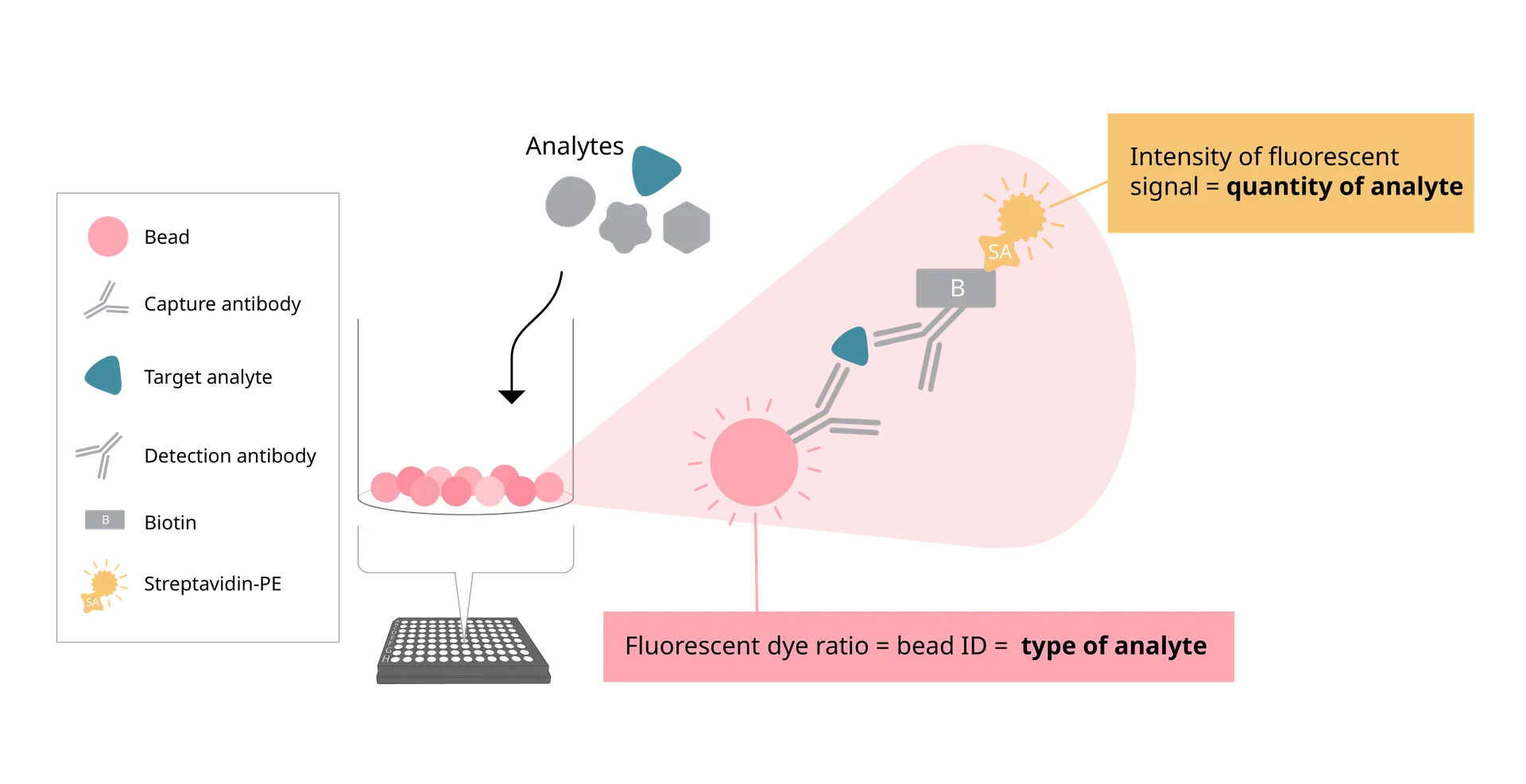
At the core of EYRA’s precision is the RAWsphere image analysis algorithm. It identifies each bead, links it to the correct analyte, and quantifies the PE signal with high resolution. Whether you’re measuring six cytokines or a full 30+ panel, RAWsphere ensures your multiplex data is accurate and reproducible.
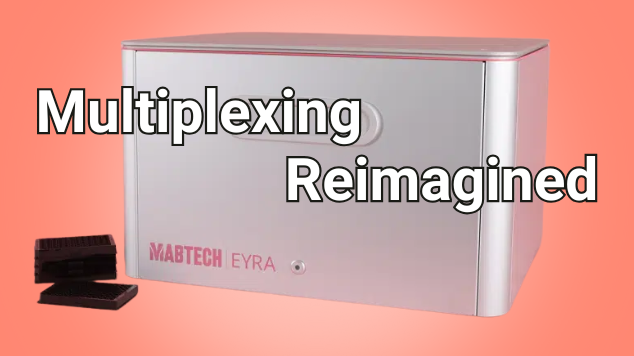
Watch video to see how EYRA works
Fluidics-Free Technology
EYRA is built around a completely flow-free design. No sheath fluid, priming, waste handling or blocked probes.
Instead of pushing samples through fluidics, EYRA uses confocal microscopy to image settled magnetic beads directly in the wells of a 96-well plate. Each bead carries a unique fluorescent dye signature for identification, while analyte-bound PE-labelled antibodies provide the quantitative signal.
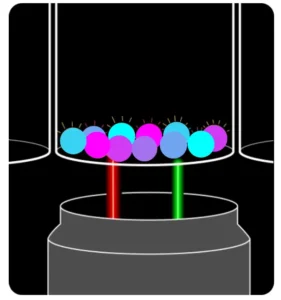
The result? You insert your plate, select your assay in the intuitive Mabtech Opal™ software, and hit read. Fifteen minutes later, you have fully processed data – with your samples never leaving the wells.
From Plate to Excel - Fast
Opal™ software comes preloaded with templates for every EYRAplex kit. Standards, plate layouts, and gating are handled automatically – so you spend less time setting up and more time on results.
Once the plate read is complete, results are exported directly into Excel, with options for bulk export if you’re working on large studies or multiple plates. No manual reformatting. No data wrangling headaches.
The Maintenance-Free Mindset
Because EYRA is fluidics-free, there’s no daily calibration or cleaning. No flushing, no wasted consumables, and no time lost to instrument downtime. It’s genuinely a plug-and-play experience – switch it on, run your plate, and walk away with your data.
Joe’s Takeaway
The Mabtech EYRA isn’t just another multiplex platform – it’s multiplexing reimagined. By removing fluidics and harnessing high-resolution confocal imaging, EYRA delivers:
- High-plex capacity: 30+ analytes per well
- Fast turnaround: ~15 minutes per plate
- No maintenance: no daily cleaning or calibration
- Accurate, reproducible results: powered by RAWsphere analysis
For labs looking to streamline their workflow without sacrificing data quality, EYRA offers a fresh, frustration-free alternative to traditional flow-based systems.
Until next time… happy experimenting!
Joe Roberts, PhD
Product Manager
Millennium Science

10x Genomics Grant Application Resources
Why 10x Genomics?
10x Genomics is a proven leader in single cell research, expanding access to single cell with optimised protocols, end-to-end support, and easy-to-use analysis tools. 10x Genomics’ technology – backed by 10 years, over 2,200 patents, and > $1.5B in R&D investment – has empowered researchers to publish over 8,000 studies, including many high-impact applications of their tools.
10x Genomics’ complementary Visium and Xenium platforms offer an essential balance between unbiased discovery and precision insights and are leading the way in performance, flexibility, and ease-of-use. Being at the nexus of spatial biology means seeing what others may have missed: global cell-type organisation, cell–cell interactions, heterogeneous spatial niches, novel gene programs, critical ligand–receptor signalling networks, and spatial biomarkers of therapeutic response.
Download grant application resources here:
Enhance your chances of obtaining research funding for your Single Cell and Spatial Transcriptomics projects with the below 10x Genomics grant application resources.


These grant application resources include:
- Technology summaries
- Applications
- Workflow overviews
- Technology Advantages
- Validation studies & data benchmarking
- Data processing & analysis
- Sample & project size considerations
- Additional resources
- References
Other useful resources:
Book a project discussion or request a quote below:
Deeper Spatial Discovery with Visium HD 3′
Visium HD 3' is here! Explore more species - Now Shipping
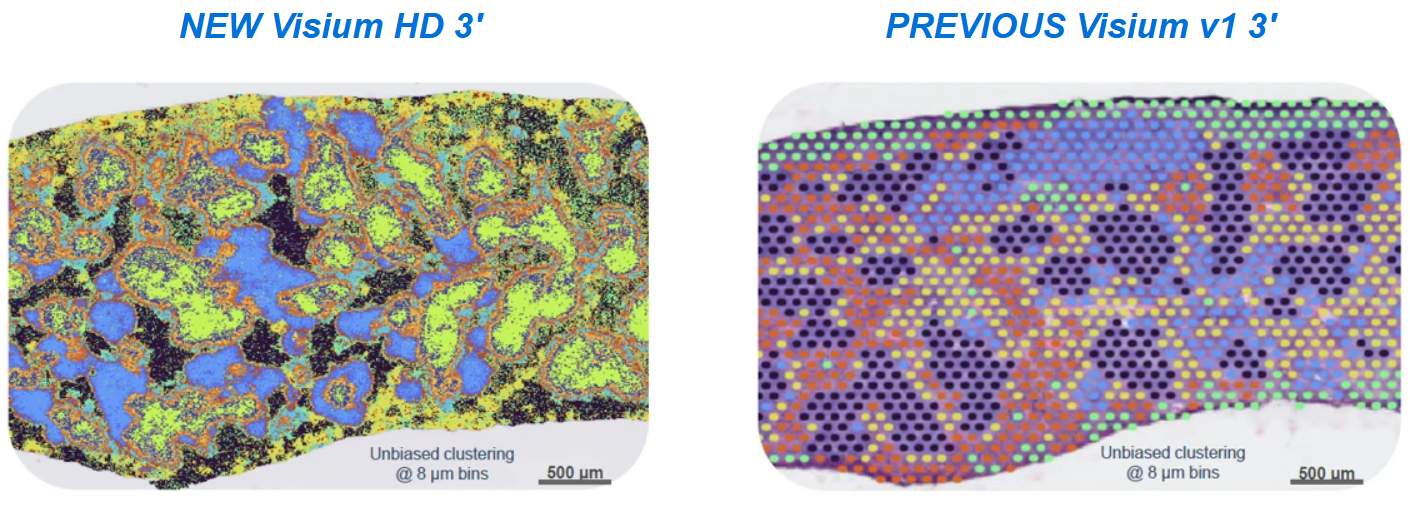
Introducing 10x Genomics‘ Visium HD 3’, a novel assay for unbiased cross-species spatial gene expression profiling of fresh frozen tissue sections mounted on a standard glass slide. The Visium HD’s array has a gapless design that enables integration of unsupervised gene expression clustering data with microscope H&E images from the same tissue section, allowing precise profiling of finer anatomical features with high tissue coverage at single cell-scale resolution.
Furthermore, this novel reverse transcription-based assay generates cDNA products compatible with both short reads and long reads sequencing, extending its applications beyond gene expression analysis to enable immune profiling and the discovery of isoforms and novel transcripts on a spatial level.
Key Features
Visium HD 3’ assay, which delivers whole transcriptome spatial analysis with a 3’ poly(A) capture-based chemistry. This assay provides:
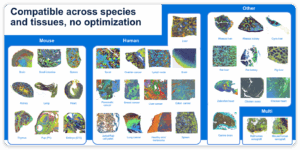
- Flexibility to explore the spatial biology of fresh frozen samples from any species
- De novo spatial discovery power, including isoforms, TCRs/BCRs, and SNVs
- True single cell resolution with new cell segmentation software
- Streamlined slide handling and high spatial fidelity powered by the Visium CytAssist instrument
Space Ranger v4.0.1 is now live! Expand the power of Visium HD with cell segmentation
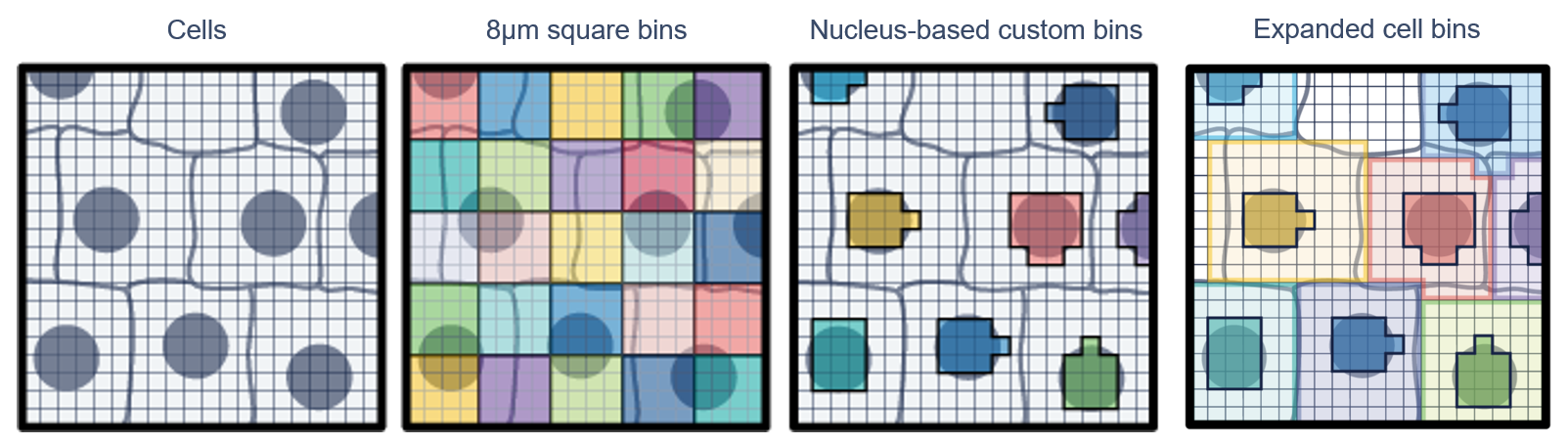
Improve cell-type resolution with nuclei expansion–based cell segmentation available in Space Ranger version 4.0 software. Importantly, Space Ranger v4.0 now supports cell and nucleus segmentation with H&E images. So you can reprocess existing Visium HD data through the new Space Ranger pipeline to derive these nuclei and cell segmentation outputs alongside the square bins
- Input a brightfield image of your H&E-stained tissue into the Space Ranger pipeline
- The software performs nuclei detection and expansion
- The Space Ranger pipeline outputs custom binning files viewable in Loupe Browser software
The new version can be found at: https://www.10xgenomics.com/support/software/space-ranger/latest
Some other notable features are:
- A new UMI-based registration algorithm for Visium HD and Visium HD 3′ data.
- You can now visualize and analyse Visium HD / Visium HD 3′ cell segmentation in Loupe Browser v9.
Watch introductory webinar on-demand
Learn more about the Visium HD 3’ assay in this introductory webinar, including a Q&A with product experts.
Build your own Visium HD 3’ experiment
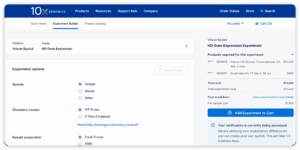
Use 10x Genomics’ interactive tool to design your Visium HD 3’ experiment. Answer questions about your sample types and experimental goals, and get kit recommendations.
Other Resources
Press Release: 10x Genomics Expands Visium Platform with Launch of Visium HD 3’ Gene Expression, Unlocking Deeper Spatial Recovery
Grant application resources for Visium products
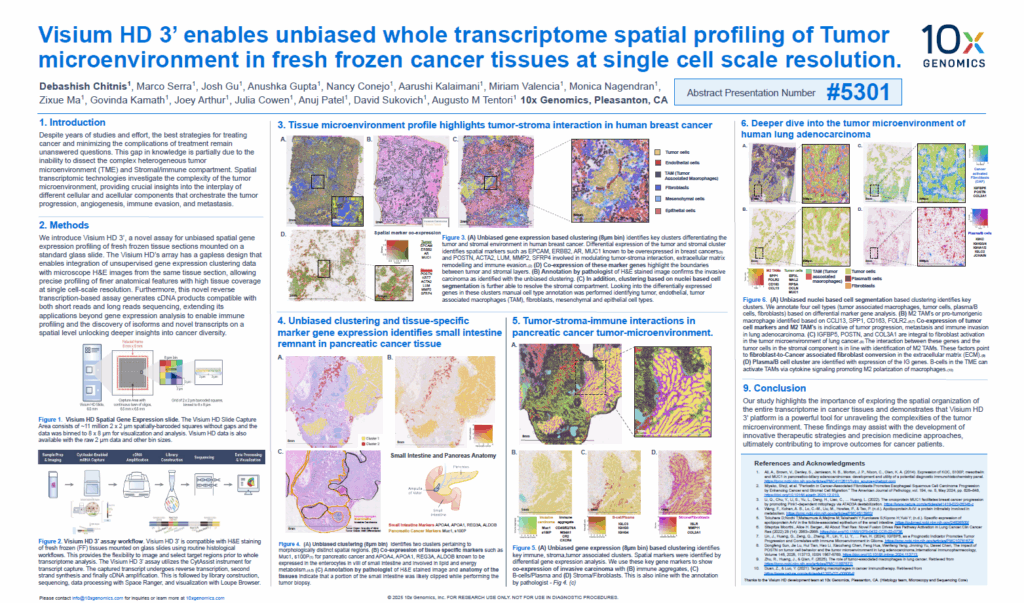
AACR Annual Meeting (Chicago) Visium HD 3′ poster: Visium HD 3’ enables unbiased whole transcriptome spatial profiling of Tumor microenvironment in fresh frozen cancer tissues at single cell scale resolution.